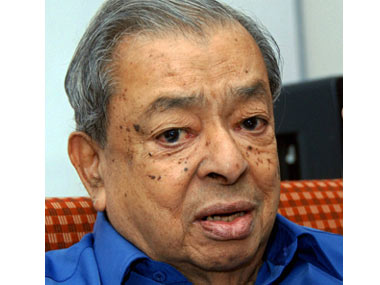
I change my Facebook Display Picture, also known as the DP, every once in a while.

There is no system, no pattern, no specific period. Just when I feel like it. Perhaps when some new photos have been taken, and I find one of those interesting enough, to make it my DP.

Most times when a new DP is chosen and the update goes out, there are a few likes, a few comments, on that post.

A very typical reaction, that one.

However this time, it was different.

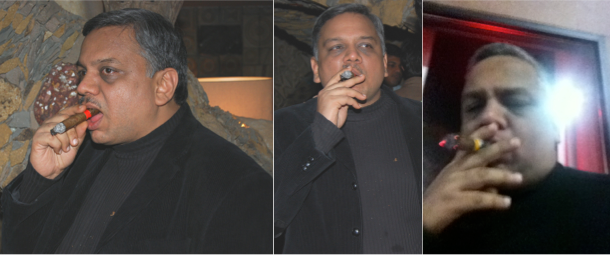
Few days after the Social Wavelength party recently, I put up one of my photos taken then, as my DP. This was the photo that I used:

The responses I got on putting this photo as my DP, were truly surprising.

While there were the usual likes and “nice pic” kind of comments, there were other stronger reactions.

One of my friends wrote: “Hate”

Another said “it was a bad ass photo”

I was told via a comment that “a person of my stature should not be endorsing smoking..”

Again, another said, “Bad message, Sir..”.

Besides the few comments on FB, there were three direct messages on FB suggesting that I should remove this pic.

And TWO SMS messages too!

And finally since Diwali was just following, there was a card that I got, where a dear relative also added her wish, that “may I give up smoking this year”.

BUT I DON’T SMOKE!!

Yes, I do smoke the cigar, perhaps 3-4 times a year. Okay, at most 6 times a year. But that’s it.

I don’t smoke cigarettes. And I smoke nothing else, the whole of the rest of the year.

So the reaction, on Facebook, via SMSes, and that card, were all surprising, to say the least.

It was not the first time that I have used a pic with a cigar on Facebook. There have been other photos in the past such as:

At no time in the past, have I got anywhere close to the kind of reactions that I got this time.

So I wondered about the possible reasons. What’s changed this time?

  1. Is it really about some kind of stature thing, and giving some kind of message?
  2. Is the anti-tobacco consciousness grown a lot more, and people are just a lot more verbal with their strong views, which they express now?
  3. To my smoking the odd cigar or to my putting up some kind of photos, I had always got reactions from my very close family in the past. But this time, it was beyond the close family. So I wonder if the regular exchange that we have on this medium, on various topics, makes a lot of us “feel” closer in terms of our relationships? Do we feel it to be okay to make some suggestions / comments to our friends, which earlier might have been a little more ‘personal’ type, in nature?
  4. Do these people just care for me a lot? All of those who said that the pic was not good, are very dear friends. And they are my well-wishers too. So it could easily have been their genuine caring for me, to want me to not indulge in habits of this kind.

I am not sure what was or were the reason(s) for the responses that I got.

I considered changing the DP quickly, on reading those responses. But I did not change it.

At one level, I do want to be free of the ‘responsibility’ that my actions need to be a “message” for others. I certainly want to live life on my terms, as much as possible. If I had taken off the pic immediately on seeing those reactions, I would have placed myself in the position of having to keep a certain appearance. Which is largely acceptable to others. But which I may NOT be.

I did not want to go there.

Just because social media makes us a little more visible (of course, to the extent that one desires oneself to become) does not mean that one’s every move needs to be subject to scrutiny.

For the record, I do NOT smoke all year / all day round, as I have clearly mentioned.

I do NOT believe smoking does any good to people. I am concerned about the number of people in our office who smoke a fair number of cigarettes daily. I am concerned for them, for their healths, for their future. I wish they’d start giving up the habit.

For now, I still retain the desire to have an occasional cigar, and indulge to that extent. I may choose to give it up some day. That day hasn’t arrived just yet..

Oh, and by the way, I HAVE changed the display picture now.. much after the reactions came!

Political parties are also large organisations and require management, as much as corporates do.

The Obama team is a classic example and would have all elements that make a corporate organisation, from management positions, IT teams, distribution networks, and what not.

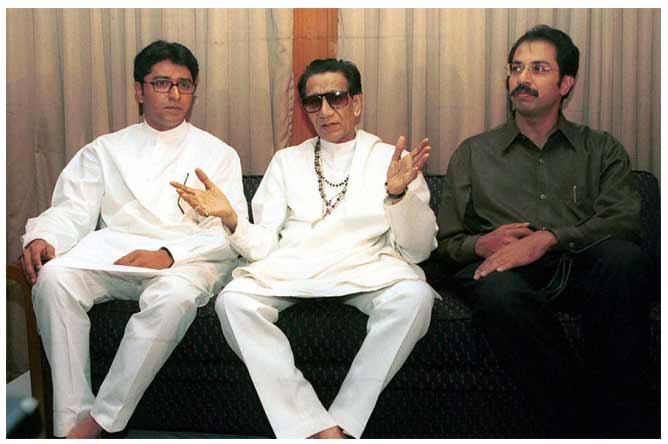
The recent events post the demise of Balasaheb Thackeray had brought into focus, some interesting management parallels:

1. Charismatic Leader vs Strong Organization: 

So we saw lakhs of people on the streets paying homage to the departed Balasaheb, and several more glued to the television screen.

Undoubtedly, the man had a massive support base, and the numbers tell the story.

And yet, there are questions asked about the future of the party after him?!

Very ironic.

The same party whose leader’s death generated such a massive response from the people, may have questions about its future, post his demise!

This is a classic case where an organisation needs to find the right balance between a charismatic and popular leader, while also building a strong base of the organisation itself.

Organisations do need good leaders. And these leaders also typically have a larger than life presence. Bill Gates, Richard Branson, Steve Jobs, etc. are all leaders of that kind.

Yet, Gates managed to pass the baton smoothly enough.

Questions were raised about Apple post-Jobs, but the company had enough inherent strength and a strong leadership team, that belied any doubts that may have existed in people’s minds, about the company.

In all these cases though, the outside world, while having seen a good leader, had also experienced the strong brand underneath.

Political parties have a slight difference. The leadership HAS to be even stronger than a corporate leader. It is on the strength of the leader, his oratory skills etc. that the party wins or loses elections. There is a very strong association of the leader to the brand of the party. Which is the case with the Sena at this time.

Sena = Balasaheb and Balasaheb = Sena has been the association, with the result that there are a lot of question marks amongst ordinary people, and perhaps the party cadre also, about the future of the party.

Which leads us to the point of succession planning.


2. Succession Planning:

Large organisations with huge stakes always worry about succession beyond the current leader. The boards of such companies realise the enormous stakes and usually have a plan in place, for succession.

If the leader is young enough, the plan may be a concept, but as the leader advances in age, and approaches a retirement level, then the plans get more specific.

The well planned identification of a successor to Ratan Tata, and then the year long transition with Ratan Tata being beside Mistry, is an excellent example of good succession planning.

Which sadly did not happen so well at the Sena.

Well, Uddhav has been leading the party for a while now, but for any kind of impact, be it at the Dusshera event or during elections, it was still Balasaheb who had to lead from the front. In a sense, as was his classic statement when the Sena was in power in Maharashtra, he still held the “remote control”.

I am sure Ratan Tata will hold no such remote control at the end of the year. Perhaps he has already put it aside! And that is where the difference lies.

Now this could have happened because Uddhav did not show strong leadership abilities? And had to depend on Balasheb’s presence to make any impact to the masses and to the cadre.

If that was the case, and if ultimately the organisation was bigger than the individual, there should have been boldness to bring in a better leader! But transition to the new leadership was a must!

Not that Balasaheb passed away suddenly. There was time enough to plan this well.

But then again, unlike pure professional companies, when it is a family owned / run company, it is not always the best interests of the company that impact decisions, rather, it is the best interests of the family. And sometimes these best interests may not be so right for the organisation concerned.

Such challenges have been seen in companies, and it is certainly no surprise that the same are seen here in a political party.

Then again, there are family run enterprises in India who think bigger and bolder today, and do bring in professional management, and realise that the organisation is a bigger asset and they must do what they can, to ensure its continuity and continuing growth. Those families who make this transition for their companies, have managed to sustain long term growth.

Others have seen the decline, usually by the time the second or third generation of the family takes control of the companies (there will be the rare exceptions to this).

If the Sena could have also thought about going beyond the immediate family, the future might have looked more secure.


3. Insecure to give us the throne too early?

Today’s political parties in a sense, resemble the erstwhile kingdoms in India.

And there have been many moments in history, when the prince has usurped the throne from his father, the king, or even put the king behind bars, or even had him killed.

Just to get the throne.

Sibling rivalries were even more common.

Political parties are not too different.

Would a leader worry that if he hands over the reins too early, he will be relegated to a life without importance, without power, without clout?? Does that make even an old leader to keep his hold on his seat of power, and not make way for the successor?

We have seen such incidents even in the corporate world. Apollo Tyres is an example that comes to mind.

It is a rare individual who having enjoyed tremendous clout and power, is able to move away, into a life of relative calm and away from it all. Perhaps the need is to find another purpose, a different passion.

Bill Gates comes to mind. His passion for his current goals ensures that he doesn’t miss the seat of power which was the Microsoft Chair.

4. Branding sticks!!

When we work with brands, and sometimes see the extreme finickiness that some brand managers display about their brands, we may wonder why so.

But over time one realises that brands are built over long years, and once a brand it built, that perception sticks. Usually for long, long time!

If a particular telecom company gets slotted as a cheap and poor service company, it is extremely hard to get that impression out, no matter what it does.

Yes, brand reputations stick for long.

Which is why we are seeing the strong anti-Thackeray and anti-Sena emotional outpour.

The smallest incident of unrest in the city, at this time, and people are ready to condemn the Sena. Whether the incident was doctored by the Sena leadership or some local goons, it does not matter.

NRIs from far and wide recollect the violent incidents that they had experienced when they were in India, many years back, and that is the perception they carry about the Sena.

So it does not matter now, if the Sena leadership had instructed their cadre to stay calm and peaceful, and largely the peace was managed. Their past, their reputation, hounds them. And can’t be shirked off.

So there will still be many fingers pointing at the Sena, even if it was proven than non-Sena people had done some damage, that will not be believed, and the Sena will get the blame.

Yes, a brand’s reputation becomes its legacy. Can’t get it off easily.

The same is true for corporate brands. Which is why I appreciate more now, the obsession that some brands display, on getting all communication just right, from their brand’s point of view.

It is important that the right brand perception is created and maintained too.

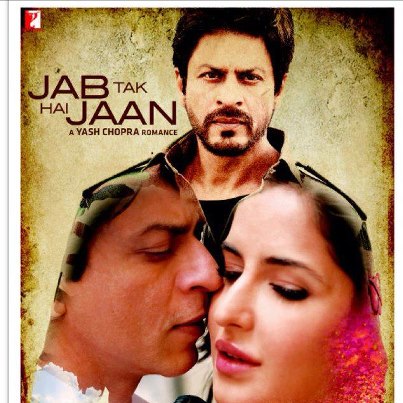
If you are a fan of Hindi films, just watch Jab Tak Hain Jaan (JTHJ) for the beautiful tribute to Yash Chopra, at the end. For the wonderful entertainment that he provided to us, all these years, the excellent 3-4 minute salutation (almost certainly, an Aditya Chopra piece of work) with the titles at the end, was very touching.

There are other reasons to see this film too, though many of those connect back to the man himself, Yash Chopra.

1. Yash Chopra uses the camera like a pen, and creates poetry out of the sheer brilliance of the camera. And this is not just the superb locations that he has caught on camera or the near perfect sets, but also the emotions that he captures from the actors, just via his camera.

2. Beautiful sites of Ladakh revisited in a film again, the countryside of UK, made for great viewing on the screen.

3. Gulzar for lyrics and A R Rahman’s music. Two of the best proponents of their respective trades contributing to the beauty of the film. On their own merits, and without any other support, these two giants would lead a movie to great heights. Here of course, they are a part of a large canvass.

4. For a change, Shah Rukh Khan does not overact. In fact, he acts “just right”. The intensity of his face, the underplay of his emotions, serves his character really well. Thank God for the absence of his hee-haw way of talking (or is that reserved only for Karan Johar films – either ways, thank God!). I am sure Yash Chopra had a role to play in bringing out the best from SRK.

5. Anushka’s role could have easily have been a two-bit extra kind. But the spunky girl that she is, she makes the most of the opportunity and turns the role into a substantial one. Comes out strong and significant.

6. Katrina looks good. Period. 🙂

7. After Zindagi Na Milegi Dobara, once more Katrina is shown on a two wheeler with a helmet on, and then getting more to her lips than the Slice mango drink, viz. another lip lock scene, this one with SRK, of course. After ZNMD, directors who cast her, may make this a habit, and she could soon challenge Emran Hashmi for being most kissed star?! #JustSaying #NotThatIMind

8. The trench coats. Burberry, I presume. The bike rides in the mountains. Looks majestic.

9. Aditya Chopra’s poetry and dialogues. Some good lines through the movie.

10. Katrina looks good. Did I already say that earlier?

So is it all good? Not really. There are some misses, and some questions, and some general observations:

1. Not much of  a story. A bit far fetched. But the glitz covers up for this.

2. Are there really so many bombs needed to be diffused all the time? And while the one guys playing with death can walk into it, unprotected, do the other folks around him have to be equally casual??

3. Does a foreign country policeman allow a brown faced Indian to casually walk in, claim himself to be an Indian Army person (no checks) and attempt to diffuse a bomb? It’s like on a flight, someone falls sick, and they call out, “is there a doctor on the plane?” – don’t think they’d do that for bombs, “is there a bomb diffuser around here?”!!

4. The second time in a Yash Chopra film that someone bought birthday gifts year after year, but did not give them to the child. Saved them till later, with letters, and the person ended up getting them all together, years later. Lamhe and now, JTHJ. No new ideas around this, Yashji?

5. The film was looong. At least in our theatre. Perhaps because of a long interval too, with lots and lots of ads running in the break. Took nearly 4 hours by the time we were done and out. The film could do with a tighter edit too. Cut 15 min off at least.

6. What’s this obsession for moms to give their wedding wear for their daughters to wear?? Don’t they realize that: a) 25 years is a long time for that dress to be totally out of fashion and b) don’t you feel for the fashion boutiques who will go out of business, if this trend continues and becomes popular?! 🙂

7. The other characters in the film, like SRK’s cronies in the army and in UK, Anupam Kher, and all others, have pretty much, no role. Those characters are just not developed. Seems like a waste.

Outside of the film, noticed that advertisers are back with in-theatre advertising. For the multiplexes having rare full houses, the additional income from other sources, including advertising, builds sustenance.

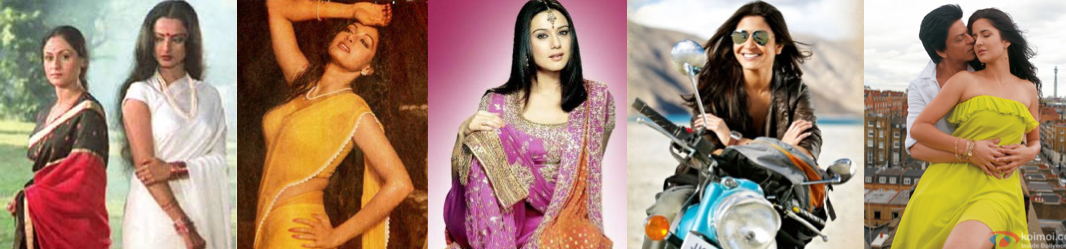
A closing word on Yash Chopra. Where other directors of earlier times seem to have lost their connect with the new audience, Yash Chopra continued to evolve himself, kept pace with the changing generations, and kept making his films look good for the times. He made his heroines look good, with the best fashion of the times, even as he evolved from silk and chiffon sarees to bright and colourful short dresses.

It is a very interesting phenomenon that one observes. Especially in times of social media and self expression and where everyone’s a publisher.

That there is a reasonably strong feel amongst the educated Indians, that corruption is not good for the country and that politicians and others who are resorting to these means, must be punished.

But when there are efforts from _someone_  or _anyone_ to do something about this menace, there are objections raised.

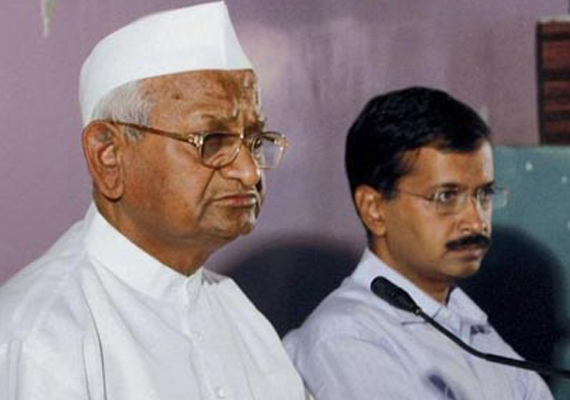
It happened when Anna Hazare protested. It is happening now even as Arvind Kejriwal exposes one scam after another.

There is a disagreement on the methods being adopted.

And hence a disagreement with the individual concerned.

There was a list of people who contributed to Kejriwal’s organisation, which was published.

And no sooner was that done, there were a fair bit of disclaimers and denials that came out from the people named therein.

Because they did not want to be associated with the means that Kejriwal was adopting.

Besides those few whose names came out as contributors to Kejriwal, many others all over Twitter and Facebook also found objections to his means (like they’d found in Anna Hazare too).

Arm chair activism in full flow. With strong arguments as well.

So cool.. this is how it is:

“Yes, I am sitting in my arm chair.

Yes, I dislike corruption.

Yes, I hate those reports about large sized scams, politicians and other heavyweights getting away scot free.

Yes, I wish there was a solution.

Yes, I am happy that someone is making some noise and trying to do something about it.

But hey.. No, I don’t agree with THAT particular thing that he just said or did.

No, I disagree with the methods he ia adopting. ”

—–

So where does that leave us??

Do you have another plan? Do you think sitting in your armchair and wishing for that perfect solution will make it happen?

Do you even have a paper concept of that perfect solution??

Do you know what it takes??

Guess not!

And yet, you will keep finding faults when someone is doing something.

So I take it that you don’t really care about the problem as much. And you are fine with the fact that we are becoming an increasingly corrupt society, and our children will not be able to make any headway in life, without needing to pay their way through.

You are willing to accept that reality for tomorrow.

Is it?? Or is it not?

If not, then what are you really doing about it, except for finding faults with someone who is making an attempt?

Are you are part of the solution or a part of the problem?? 

The simple fact is that:

a. Someone is attempting to take the fight against corruption

b. He has his set of convictions and he is following those, both in intent and in effort

c. He is out there, walking his talk

d. You can agree with his broad convictions and integrity, and may not agree with everything that he does

e. That’s fine. Once you contribute (time, money, support) to a broad cause, stay with that. Does not matter if some of the means are not the perfect ones that you’d have liked to be adopted.

f. If you do not agree and cannot support, and would like things to happen in a certain way, what choice do you have? Heck, go out and do it yourself. Become an activist and walk YOUR talk.

g. Because there is no other way. This is NOT Burger King. You CAN’T have it your way otherwise!! You cannot order “a custom-made NGO that will do exactly what I want it to do” or “a new political party that will obey my every command”.


I know that I am unable to be on the street, fighting the corruption war, in a way that I would like to. So I am happy with an Anna Hazare or an Arvind Kejriwal who are doing their part. I will support them, and wish them the best. Even if I find an odd objection in their methods.

And this other absurd expectation that people have. That you should be spotlessly clean before you raise a finger against the politician for being corrupt. What nonsense that is?? I could be trapped in a system or I might have not had the courage to stand up against corruption so far. That does not mean that I don’t have or can’t have a desire to live in a corruption free society!!

I did not go to check if Dale Carnegie truly knew how to make friends and influence people. In fact, I don’t know if he had any friends at all. I didn’t care. I liked the material in his book and that was enough for me.

Likewise, if Kejriwal and his team have good material, I will support them. Not check if there is an odd old skeleton of sorts, in some of their cupboards’!!

What do you think?

Vienna Musings

Posted: October 13, 2012 in Uncategorized
Tags: , , ,

Over the years, work and business has taken me to different places.

In early days of my career, I started out on sales calls locally, then to nearby places like Pune, gradually to Gujarat, and then to other parts of the country. There were contrasts to be studied at each new place, in terms of culture, behaviour, priorities, etc.

Export and import activities in my family business took me to Singapore and South East Asia few times, and then once we embarked on the Homeindia.com story, US became a regular port of call.

When you look at things from a distance, you can club some places (and their people) into thematic groups. So Mumbai is one, most of second tier India may be grouped into another, S E Asia is different, and then US/Canada are different. The actual city or place aside, there are many similarities within a group.

This recent visit to Vienna, in that sense, introduced me to a different genre of place and people. Although a part of Western Europe, and having its similarities to an extent with the “western” world, I’d say, Vienna is different from the US. A lot.

Some pointers – Austria’s just about 8 mn in population, Vienna is 1.6 mn. A total of around 1 mn on Facebook, for the country. Twitter’s not hot yet. When you see directions from the city, to places like Bratislava and Budapest, when companies get their work outsourced to nearby Croatia or Romania, when companies do business in Georgia (the country, not the US state) and Turkey, it is clearly a different land.

Overall, Vienna’s a place full of history, from the great emperors of yore, to the World Wars, of palaces and gardens, of awesome old buildings, of churches and of coffee houses. Also of the great huge Vienna woods, of peace and quiet (no security outside the chancellor and President’s residences; the President drives to work on his own; saw the Mayor exiting out of a coffee house, just as we entered – no fan fare, no gun totting security men!), of a strong German influence, of innovation, of music, art and culture (museums galore, huge tradition of Mozart, Beethoven and the rest).

A couple of really interesting initiatives that I noticed..

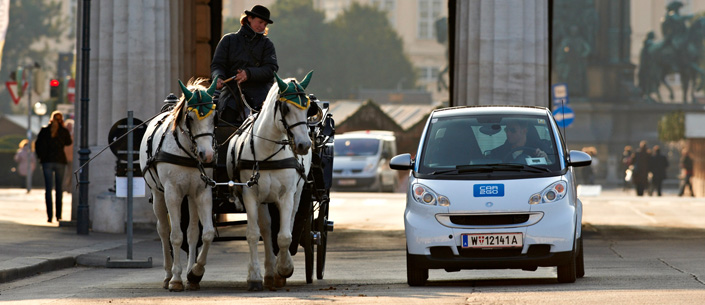
1. The Car2Go concept: There are 500 smart cars under the Car2Go concept, all over Vienna. One joins the service and gets a smart card, that can open the door to any of these smart cars. When one wants to use the car, through a mobile app, one can locate the nearest parked vehicle. Go there, enter the car, the keys are inside, drive to where you want to go, and then park it safely, leave the keys inside, walk out and leave! That’s it.

You are clocked for the minutes of usage, and charged accordingly.

2. Handy parken – street parking made simple via mobile app: You go park somewhere on the street. You use your phone app and register the parking there, and pay for a few minutes. You get delayed in your meeting, from the same app, you register and add minutes. When a cop comes and wants to check if you have paid for parking, he uses the phone app, and checks for your car number.

Amazing, isn’t it?

Great application idea..

Speaking of amazing ideas, at the conference that I was speaking at, the only other English language speech was by the person talking about the Live Singapore project, which is an alliance of Singapore and MIT.

It was absolutely mind boggling. They are picking up the amazing amount of digital trail that we leave, to map and understand a whole bunch of things, e.g. mapping the presence of people (as understood by mobile location signals) and mapping the public transport system together, they are able to see where people are concentrated, and if public transport is planned to meet those people needs. Likewise they are able to see electricity consumption patterns mapped with rise in temperature, movement into and out of the city, changes that happen during large events (e.g. F1), etc.

Check this video – it is awe inspiring, and gives us a taste of the future:

Yes, all in all, it was an interesting 4-5 days in Vienna..

🙂

Read a very interesting piece in the Mint Lounge, by Niranjan Rajadhyaksha, referring to some people beyond the realm of politics and Bollywood and cricket, who have been hugely impactful in making India what it is today!

One of the persons he talks about, and about whom I had also written a bit few days back, is Verghese Kurien, the man behind India’s white revolution, and self-sufficiency in milk, farmer empowerment, etc.

As Rajadhyaksha puts it really well, “There are three ways to judge the impact a person has on his times: the number of lives he touched through his work, the strength of the institution he built, and the team he left behind to carry on the chosen task.”

And even as we feel good about the little we may be doing in life, when you consider these benchmarks, we would realize that we are nowhere. While it is very tough to rise on all of these aspects, we can attempt to do our best in touching more live, creating a strong institution, and leave a strong and empowered team when we choose to move on.

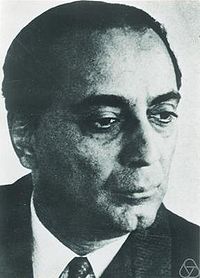
Institution building is not something that only happened in the early years post-independence. While Rajadhyaksha talks about personalities like Kurien, Homi Bhabha and Vikram Sarabhai, it is interesting to see him list current day personalities also, such as E. Sreedharan, the man behind Konkan Railway and Delhi Metro, or R. H. Patil, the force behind the National Stock Exchange.

But it is also a fact that being an institution builder is an attitude that is not commonplace. Can you look at a 20 years horizon? Or you are worried that you don’t know what will happen 3 years from now, and hence think in the short term? I remember vividly, an old gardener, at a nursery in Coorg, where he was painstakingly, but lovingly, putting together, the saplings that would go out to create trees. And on the outside of the nursefy, I saw the humungous trees that would have come up in 20-30 years. Clearly, the gardener may not see the saplings flourish into those large trees, but that did not deter him from putting his most into the effort, and lovingly too.

The institution builder thinks of a bigger picture, the grand vision. And that’s what makes a Vikram Sarabhai or a Homi Bhabha.

Interesting words from M.G.K. Menon, who succeeded Bhabha as director of the Tata Institute of Fundamental Research, about Bhabha: “The legacies he left behind are not only the tangible programmes, buildings, equipment, gardens and the like, visible creations of his scientific and artistic abilities; but even more important is the legacy which is in some sense intangible—the large number of trained personnel, who have embraced the vision of a new India and who have acquired confidence in their own abilities. (Patrick Maynard Stuart) Blackett has often stated that a first-rate laboratory is one in which mediocre scientists can produce outstanding work. Homi Bhabha … understood this well and this is what he sought to create by the right environment and the right conditions of work.”

When we think of the nuclear program we have in place today and the strides that we have made as a country, the paragraph above brings the goosebumps. Imagining those days when he must have struggled to get the program going, and kept going forth relentlessly, so that we can see his legacy now.. how awesome!

Towards the end of his piece, Rajadhyaksha asks very pertinent questions. Are history books today filled with freedom fighters and (worse) other politicians, or even perhaps, sports personalities or iconic film stars, but do not have a mention of some of these great men and women, who built the real India?

Will the young generation have the understanding of who built the India that they now enjoy and take for granted? Isn’t it the duty of today’s generation to acknowledge these deeds?

Also are there any in our society today, who can be considered such institution builders? Are we encouraging them enough? There is still a lot to do, and we need today’s Bhabhas and Kuriens and Sarabhais..

Every now and then, we will experience a feeling of HIGH. A point of extreme happiness, deep satisfaction, an urge to celebrate.

And no, I am not referring to the point when you have had one too many at the bar.

I am referring to that feeling of HIGH coming off an achievement, the feeling of success.

So what makes you feel high?

Is it an interesting point in the journey or is it really a destination? If you feel the high in the middle of the journey, chances are that you may falter for the rest of the path, till you reach the destination. Or NOT reach. Because when I say ‘high’, I mean, the zenith, and everything else, being lower comparatively.

 There is often an extreme enjoyment in the journey itself. Many people are in the game, only because they enjoy the journey, and not necessarily focused on the destination at all.

Let’s look at examples.

Entrepreneurs I have met, especially tech entrepreneurs, have fallen in love with the technology that they have created. Some amazing application (well, at least from their point of view), say. And when the early adopters use it, and give them very flattering reviews or responses, their life is already made.

The worst (unfortunately) thing is when they get an award, or get recognised as the most exciting tech app, or something like that.

The high is so strong that everything that follows is lower comparatively.

The reality is that to reach the ultimate success for the venture, there is a long road ahead, after that initial appreciation. Size needs to be built, concept needs to be sold to a larger audience, money has to be earned, etc.

But they somehow keep putting these activities off. Giving themselves some or the other excuse. Like they are fine-tuning some part of the tech, as it will make the app even more powerful. As if it was not sellable in the current form?!

But all this happens because the HIGH has already come and gone!

Another example could be a student who does really well, tops the school say, in the preliminary exams before the Boards. Teachers and Principal all congratulate him. What if his high is already reached, and in the few weeks left for the actual board exams, the student does not put up his best?!

Let me give examples closer to a business.

Let’s take creative teams in agencies. They slog nights, dozens of coffee cups, scores of cigarettes, to then come up with the brilliant idea. Which they go and pitch and the client is floored. Wah-wahs follow. The client can’t stop praising the creative. There are high-fives and what not. And then the client slips in a small message at the end, that “make these small changes and get back”.

And those get forgotten, or ignored, or not worked on with half as much interest… and the next meeting with the client, is a disappointment, perhaps?

Or a sales guy, who works hard on the pitch, gets it all right, goes and pitches, and the client is very happy. Gives him very encouraging words. It is a HIGH for the sales person.

Except that unfortunately, that is NOT the destination. Where’s the Purchase Order? Oops, in all that celebration of the great pitch, it was forgotten that the PO was to be asked for. Or to be pursued later. Because POST HIGH, IT IS ALL LOWER.. !

The point being that, while intermediate achievements need to be celebrated, there has to be a consciousness of a bigger destination ahead. And that we are still a work-in-progress. And hold back the big celebration till the actual destination is reached.

And for which, there has to be clarity of the big destination to begin with.

For the student, it is not the preliminary exams, it is the main board exam!

For the tech entrepreneur, it is not the appreciation from contemporaries or the tech award, but the commercial success of the venture.

For the creative guy, it is not just a great creative pitch, but the winning of the account.

For the sales guy, it is not the appreciation of the great pitch, but the receipt of the PO.

So what journey are you on? What is your HIGH point? Are you clear? Are you working towards it?

As for me, whether it is a client win, or an investor coming on board and giving us value, the HIGH point is when the cheque is in the bank. Everything prior to that, a PO or a contract or a term sheet, are all work-in-progress points!!

So iPhone 5 has generated a record 2 million units of pre-orders within 24 hours, and which is nearly twice the quantity that was received for iPhone 4S. Apple shares climbed up beyond the $700 mark, and the company continues to get more and more valuable.

Image courtesy The Business Insider

And yet, when you see some of the reports and reviews that came up, after the iPhone 5 was revealed, it would have seemed like the iPhone 5 was not such a big deal after all! The Android and Samsung fans were particularly rejoicing as they felt that the iPhone was finally losing its way now. They saw a lot of joy in the bold Samsung ad with a feature by feature comparison that showed how Samsung would make a smarter choice.

Coming as it did after the US court judgement against Samsung, this seemed like a great challenge back to the “evil iPhone system”!

Many Android fans created their own versions of the ads, and included a price comparison as well.

You’d think that the iPhone has finally met it’s match, and will, for the first time, see a decline in sales.

Yet, surprise, surprise!

Where the iPhone 4S (which did not generate so much of “disappointment press” as the iphone 5 did) had clocked about 1 mn units of pre-orders in 24 hours, the new one went past the 2 mn mark!!

And riding on top of that news, the Apple stock blew past the $700 mark. And the company continued to get more valuable and sexier for investors.

And something else continued to happen.

The something else that I believe, is the core essence to the story here.

The BRANDS iPhone and Apple became more and more aspirational! More coveted.

“2 million people made it to that 24 hours list, but I didn’t! I have to be the most miserable person on earth..!”  would be the feeling for many who could not get a piece of the iPhone 5.

Let’s understand and appreciate that lifestyle products are not bought with a clinical eye on features.

When I sit in a Mercedes car, I do not feel “much” different. If I have to have a purely rational view about it, I would wonder why anyone should pay the 3-4 multiple of the price over a VW that I drive? It is not really that special!

And yet, what do people earn a lot of money for? So that they may go and buy a Mercedes some day (#justsaying).

We know when we started bootstrapping Social Wavelength, we went and bought regular Windows laptops and managed our work. But in a few months, when business picked up, and we had some cash flows to spare, we went and purchased the more expensive MacBooks, and felt good about it. That is what we had earned for. That we could not get the sexier Apple machines!

So’s the case with the iPhone.

You can’t replace a Harley Davidson by just building a ‘better bike’. These are not mere products, these are iconic brands. They have delivered happiness over the years. And it will take a lot to displace their stature.

I am not a mobile phone reviewer. I don’t get the nitty gritty of comparisons here. I have never used a Samsung phone ever. But I have no reason to leave my iPhone. It gives me sheer delight. Why should I consider migration? I migrated out of Windows machines, as there WERE pain points! Not here. Not in the Apple family of products.

When I was in the Bay area in June this year, I must have taken the 1 hour Caltrain ride to San Francisco, about 10 times at least. And I could see nearly 80% of the passengers busy with their mobile devices. And the most common devices visible out there, were the iPhone and the iPad. And the passengers were not necessarily folks who had sold their startups for a lot of money!! These were people doing jobs in the city, or students, and such.

Clearly the device to own, was one of those Apple ones – the iPad or the iPhone. And those are the kind of folks, contributing to the folklore of Apple. And which explains this phenomenal surge or pre-orders and the sky rocketing stock price of Apple.

I have seen enough of the tech world to know that nothing is permanent, and there will be a change of guard at some time. It may take a bad move from Apple to shoot itself in the foot, or some other inflexion point to knock them off their pedestal. However, none of those events are visible in the horizon.

Till then, Apple continues to rock on.. !!

A visit to the crematorium makes you do this.

Ponder.

And as I stood there earlier this week, I pondered over the two deaths in the previous 2-3 days.

One of course, was that of a well-known person, and I read about the demise in the papers.

The other was a very dear friend whom I have known for more than 20 years now.

There is a strong emotional aspect to the latter case, but that is not what this post is about.

The connection I saw in these two deaths, was the strong legacy that both left behind.

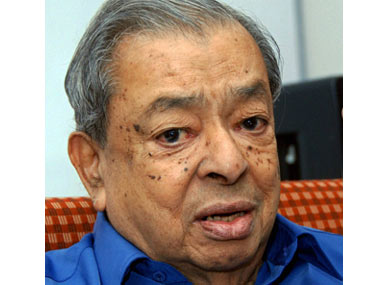
The first one that I refer to is of course, Dr. Verghese Kurien.

My knowledge about him is from what I have heard and read in public domain, plus some insights gained from someone who worked very closely with him, as one of his early lieutenants, for upwards of three decades!

Known as the milkman of India, or the father of the white revolution, Dr. Kurien was responsible for India to become not just self-sufficient in milk production, but also become the world’s largest producer of milk. But that may sound like someone setting up a large plant for manufacturing some items.

That was not the case.

What Dr. Kurien managed was to generate huge respect, livelihood and security for lakhs of dairy farmers, by creating an amazing movement, known as the cooperative dairy sector. The model that he successfully created in Anand, was replicated in various parts of the country. The brand Amul is one of the most revered brand in India, and as they say, they have products for people, right from birth until death!

His lifelong dedication to a cause clearly impacted millions of people, and the universal acclaim and tributes that flowed at the time of his death, was an indication of the impact he created.

Here was a life lived to the full, rich and memorable. Leaving an amazing legacy.

Well, not everyone can be a Dr. Kurien. Most of our lives are far too ordinary, relatively speaking. But can we still touch many lives, leave our impact on this world..?

This path was shown by my dear friend, Dr. Mandakini Parihar, who passed away, way too soon, earlier this week.

But she too lived a rich life, consciously touching all those she connected with. Friends, family, co-workers, friends’ children, children’s friends, patients.. everyone!

As she battled the big bad C disease, the number of prayers and good wishes flowing for her, would have been massive. She was a true friend, always there, always helpful. You could go to her with any issue, and she’d always have a calm, collected and wise response / suggestion. Our kids grew up together. Clearly most of the kids in our circle had the best connect with her, felt comfort, and yet, got some of the most important lessons from her.

Her profession enabled her to virtually enable life. She was an IVF specialist, and her kind and caring interactions with her patients, endeared her to them, far more than a doctor would. That she was responsible for many of them to become parents, made her God-like in their eyes. So many of her patients felt grief on her passing away, showed how she meant far more to them, beyond her role of a doctor.

AS the tears flowed and the tributes came, I could again see how good a life Mini (as Mandakini was called) had lived, and the great legacy that she left behind.

I am inspired by both of these, and feel sad for their passing away. But I do take some inspiration from their lives and want to recognise that while death is inevitable, what we leave behind is in our hands..

A GTalk friend from a close friend, even as you are clearing your work email..

While you are enjoying your dinner at a restaurant, with your family, a Banjo alert suggesting that a colleague is within 500 meters of you..

You are making a presentation to your team, and an incoming Skype call rings, even while your computer screen is projected up there..

And with such criss-crossing of life, you ending up sitting late to clear your backlog, or unable to catch up on any reading, etc.

You may consider this as a stressed out life or at least a very busy one.

I am trapped into this kind of life a fair bit, even though I am conscious about it, and have made few attempts to grapple with it.

But all in all, it is challenging.

Analyzing the situation, I am leaning towards the following reason for the challenge:

Our Unified Life on an Omnipresent Device!! 

 Where does personal life end and work life start?

Time was when at 6-30 / 7 pm or whenever you closed shop, shut the briefcase and went home, the physical separation from work ensured that one life closed and another began.

Even when laptops came by, but until the Internet was not that big, you only carried “some” homework, which perhaps you worked on, at home.

Then came email, and it got just a little more pervasive.

And it’s been all downhill since. From the Blackberry (never used one, but have known many who are / were slaves to it!), to Facebook, Twitter, Foursquare, Banjo, etc. etc. and all of their phone apps. From cheaper Internet access to 3G and now heading to 4G, so that all of these not only come to you whenever and wherever, but they also come cheap and fast!

In the circumstances, it is hard to work in silos of life.

And then, in absence of the silos, you are constantly switching, and for every switch that you do, there is loss of efficiency, and a loss of quality as well!

I continue to be in this trap, and working hard to resurrect myself.

Can I switch off my phone once I am home? I know a friend who does that. He says those who really must call him, know his home number, and the rest can wait till the next day!

Can I work with one app, one window open, and shut everything off, when I am working? So I don’t check the browser when I am on my Excel sheet, or even when I am on the browser and reading some interesting research, I don’t need to attend to the email that pops in, into Gmail..?

Can I switch off my phone at the restaurant, or at least disable some of the apps for that time?

What are the kind of changes that are required? How do I get out of the trap?

I know few – very few – of my friends who have managed to “manage” their life in this kind of a situation. Most others, including yours truly, are struggling to find a way out.

If you have any interesting solutions to suggest here, do comment..